PREPARE
About Action Research
- Understand what counts as research
- Understand what action research is
Introduction
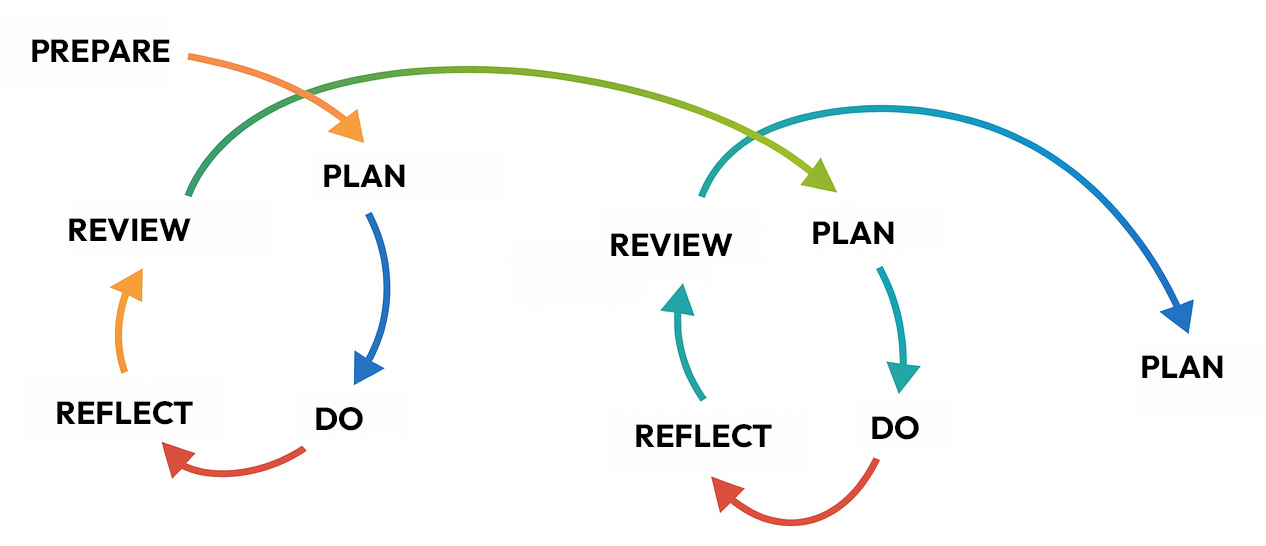
There are many different ways to carry out research in education: Action research is one of these. Doing good action research means organizing your enquiry, activity and thinking so that you learn about and develop your practice, and share this with your peers. Action research is a form of reflective practice which works cyclically through:
- Planning: teaching planning, research design and ethics, literature reviewing
- Doing: teaching intervention/ongoing practice and data collection
- Reflecting: analysis and relating your research to other practice/theory in the field
- Reviewing: concluding, reporting and sharing research and stepping into next planning phase
Your action research is likely to involve both deductive and inductive thinking:
- Deductive thinking or a ‘top down’ approach, works from the general to the specific. You might take an existing creativity theory or frame (e.g. PCC Creative Skills & Pedagogies) and narrow down to apply and try out a particular part of it in ‘action’
- Inductive thinking or a ‘bottom up’ approach, works from specific observations from within your practice to find patterns and regularities so you can then frame your own theories about what is happening
Both of these happen in action research simultaneously as your observations about practice come into conversation with existing creativity theory and the two feed each other to develop your process. Where inductive thinking is at play your process is likely to be more open-ended and exploratory, especially at the beginning. Where you use deductive thinking your process will be tighter and more focused.
Action research is different to evaluating or assessing the success of a particular teaching approach. It is feasible to carry out an evaluation study that makes a statement about the success of an approach. However, for action research to fully develop your practice, we suggest it is more fruitful to engage in research which investigates how and why an approach (or as we call it here, a ‘Creative Action’) works. Action research can tread a fine line between research that benefits your practice and advocacy which aims to push a particular approach. Staying on the right side of this line is about organising and designing your research transparently and not over-claiming from these kinds of small-scale studies.
Activity
- How will this research develop my professional learning as an educator, and my students’ creativity?
If you are working with a Dialogue Partner or group, we would recommend doing this exercise together as a conversation. Alternatively, you can complete the task on your own, using your Research Diary.
In your Research Diary file or in conversation with your Dialogue Partner, start to write about or debate your initial responses to the following questions:
- What do you want to learn and why?
- How will the activities you are planning for your students illuminate or answer your question?
- How might your teaching change as a result of your research?
- How might your students’ creativity develop as a result of your research?
- Use the following two examples of Penryn Creativity Collaborative action research to help you understand the journey in action research from initial area of interest, through the research into professional development, including personal, departmental and/or whole school development.
The how and why of teaching for creativity in KS3 English: Beth Herring was interested to explore how collaborative, immersive experiences in the classroom effect teenagers’ responses in English. Skip to the end of Beth’s report and you’ll find her discussion of how the study has reaffirmed for her the importance of allowing students creative freedom. She discusses being brave enough to take risks and make mistakes as teachers rather than just teaching content for exams. She reconsiders her own restrictions and examines how she too needs to feel empowered to change her practice.
The how and why of teaching for creativity in KS1 science: Ellen Churcher was interested in whether children felt empowered in their science learning and how they could be encouraged to take that further. Ellen knew that children in her class had a lot of scientific knowledge but wanted to delve further into how they could have greater ownership in science and generate their own lines of enquiry. At the end of her report, Ellen discusses how the project has helped her to question her practice, how she came to understand ‘stepping back’ in the classroom as a pedagogy, and how as the science lead her next steps were to explore further how children’s questions could be put at the heart of teaching.
Further reading#further-reading
There are many guides to action research available online and to buy. Famous names include Kurt Lewin, Donald Schon, David Hopkins, Jean McNiff, Jack Whitehead.
Online resources and current guides that we recommend are:
Centre for Collaborative Action Research
Clark, J., Porath, S., Thiele, J., & Jobe, M. (2024). Action research. New Prairie Press.
Education and Training Foundation
McNiff, J. (2016). You and your action research project. Routledge.
National Foundation for Education Research: How to run action research
Developing your understanding of reflective practice will also support your action research journey. A useful online introduction is provided by Cambridge International Education
Acknowledgement
We are grateful to the Creativity Action Research Award 2 (2006-7) unpublished teacher support pack as a grounding for ideas and practices shared here.
FAQs
I want to prove that a particular way of teaching for creativity works
It is possible to carry out this kind of study, but on such a small scale it’s impossible to really prove causality between your teaching actions and a particular development in students’ creativity. Questions such as ‘Does implementing X creative pedagogy develop incidences of creative skills in students?’ are much better left to large-scale randomised control trials. Even then, creativity is very difficult to measure in this way – some would say impossible. We’d advise sticking to small-scale studies that focus on how and why your Creative Action works and can be developed.
How do I get people to take action research seriously?
Doing high quality action research is about choosing questions, methods and analysis techniques that are appropriate for the scale of your study. It is also about reporting findings systematically and transparently, and making claims for relevance elsewhere in a way that is credible. No-one expects action research studies to have worked with 1000s of children. Colleagues will expect your study to work with your class (25-30 students) or even focus on 2-3 students to understand a particular issue in detail. Your peers will take your action research seriously if they can see how your study developed your practice in the well-described context of your classroom (so that they can understand the similarities to their own context and see where and how your claims have been generated). Take a look at the PCC action research reports if you need reassurance!